Report from the 2019 Summit of the Global Myeloma Action Network
The mission of the Global Myeloma Action Network (GMAN) is to improve the lives of myeloma patients around the world by raising awareness about myeloma, building the capacity of local myeloma organizations, and increasing access to medicine and treatment. Founded in 2013 by the International Myeloma Foundation, GMAN is a group of myeloma patient organizations that share best practices and a commitment to our shared mission.
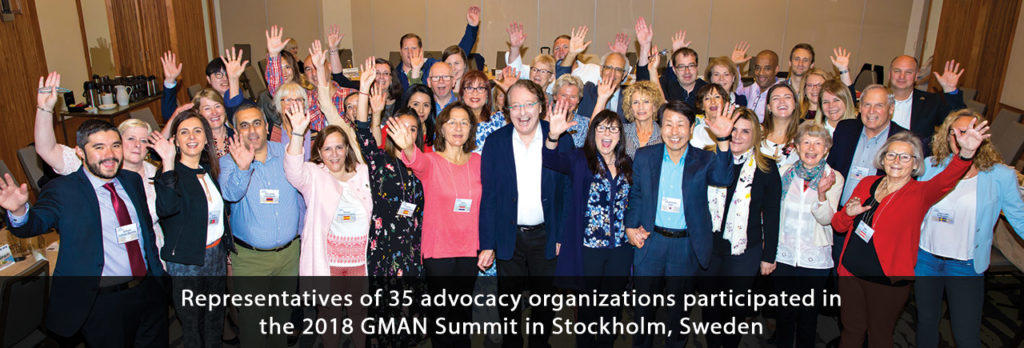
This year, the annual GMAN Summit was held in Amsterdam from June 7–9. The meeting was attended by 35 advocates representing 5 continents and 23 countries, and it was facilitated by Serdar Erdoğan (Director of GMAN, Europe & Middle East Patient Programs, and a myeloma advocate representing Turkey). Serdar presented a summary of the result of a GMAN survey of member advocates, which drove the development of this year’s Summit agenda and focused on caregivers, acknowledging caregivers as one of the key components of the patient ecosystem.

After a brief introduction, the meeting started with a presentation by
Dr. Brian G.M. Durie (IMF co-founder and Chairman of the Board), who
shared information about myeloma clinical trials conducted by the IMF.
These include clinical trials for high-risk smoldering myeloma (HR SMM),
called CESAR (in Europe) and ASCENT (in the US). HR SMM factors have
most recently been defined by 20-2-20: 20% plasma cells in the bone
marrow, M-spike of 2 or more g/dL, and 20 or more FLC (free light chain)
ratio. Having any two of the above will, on average, result in 46% of
patients progressing to active myeloma within two years. Since recent
clinical trials for HR SMM patients have shown that treatments such as
Revlimid® (lenalidomide) can delay the progression from smoldering to
active myeloma, there was a robust discussion about “should all HR SMM
patients be treated?” My takeaway, from both the GMAN discussion and the
annual Summit of the IMF’s International Myeloma Working Group (IMWG)
that followed the GMAN meeting, was that the experts are not yet ready
to make a sweeping change and will default to using clinical trials and
encouraging myeloma patients to participate in one.
One of the exciting portions of Dr. Durie’s presentation was how the IMF, through its Asian Myeloma Network (AMN), has been able to improve access to treatment by bringing clinical trials to the region. As Asia represents 60% of the world (and myeloma) population, this has a significant impact in overall survival of myeloma patients. The challenges discussed by the group were (1) how can we bring the concept of a localized patient organization to Asia and (2) how can we lift and shift the success of AMN to other parts of the world including Eastern Europe, the Middle East, and Africa.
Later in the meeting, Dr. Rafat Abonour (IMF Medical Advisor and Professor of Cancer Research at Indiana University) presented clinical trial updates for newly diagnosed myeloma and relapsed/refractory disease. Dr. Abonour covered the results of the FORTE, MAIA, and CASSIOPEIA clinical trials for newly diagnosed patients and touched on venetoclax, selinexor, isatuximab, BiTE®, and CAR T-cell therapy for relapsed/refractory patients. Subcutaneous administration of Darzalex® (daratumumab) got a standing ovation from the audience.
The recipients of the 2018 Susie Novis Durie Grant – named after IMF co-founder, President & CEO – shared the outcomes of their projects. Advocates from Spain (Mimove, a smartphone app that promotes personalized healthy nutrition and exercise), Canada (MAP – Myeloma Advocacy Program that allows advocates to humanize their communication with their elected officials), and Israel (an education campaign for early diagnosis by general practitioners, orthopedic surgeons, and hematologists) presented their accomplishments. The 2019 Grants were awarded to Columbia (Digital Awareness), South Korea (Healing Walk), and Sweden (Toolkit for Patient Preferences). We look forward to each of the grant recipients making an impact in their communities.
Next, Robin Tuohy (IMF Vice President, Support Groups) and husband Michael Tuohy (19-year myeloma survivor) presented their story, focusing on caregiving, how to talk to your children about cancer, the shared decision-making model, the importance of self-education, the need for a support organization such as the IMF, the ups and downs of treatment, and quality of life management. GMAN attendees then divided into working groups to discuss the programs that could help caregivers in different countries. It was agreed that a working group needs to create consensus guidelines for member organizations to customize with their countries’ characteristics.
A presentation of one of the most interesting topics was led by Prof. Jean-Luc Harousseau (IMF Medical Advisor) and Mimi Choon-Quinones (IMF Senior Vice President, Global Advocacy, Access, Policy & Research). The question at hand was how clinical trials can expand in smaller European countries. This can involve trained country advocates meeting with their Ministry of Health, developing relationships with potential principal investigators, and providing site qualification – quite an undertaking but something Mimi and the IMF plan to support! The success of the AMN in bringing clinical trials and novel therapies to Asian countries was discussed.
During the meeting, representatives from Takeda (future drug TAK 573 ADC), Celgene (iberdomide IMiD®), Sanofi (isatuximab CD38 mAb), and Amgen (AMG420 BCMA BiTE) presented updates on their myeloma product pipeline as well as other myeloma-related industry news.
The 2019 GMAN Summit was a great opportunity for members to renew relationships and to form new ones. There was a strong sense of pragmatic hope, driven by the progress being made in myeloma research. And there was also an acknowledgment that more, much more, needs to be done. While our in-country situations may differ, our differences make us better together.


Recent Comments