The
mission of the Global Myeloma Action Network (GMAN) is to improve the
lives of myeloma patients around the world by raising awareness about
myeloma, building the capacity of local myeloma organizations, and
increasing access to medicine and treatment. Founded in 2013 by the
International Myeloma Foundation, GMAN is a group of myeloma patient
organizations that share best practices and a commitment to our shared
mission.
This year, the annual GMAN Summit was held in Amsterdam from June
7–9. The meeting was attended by 35 advocates representing 5 continents
and 23 countries, and it was facilitated by Serdar Erdoğan (Director of
GMAN, Europe & Middle East Patient Programs, and a myeloma advocate
representing Turkey). Serdar presented a summary of the result of a GMAN
survey of member advocates, which drove the development of this year’s
Summit agenda and focused on caregivers, acknowledging caregivers as one
of the key components of the patient ecosystem.
After a brief introduction, the meeting started with a presentation by
Dr. Brian G.M. Durie (IMF co-founder and Chairman of the Board), who
shared information about myeloma clinical trials conducted by the IMF.
These include clinical trials for high-risk smoldering myeloma (HR SMM),
called CESAR (in Europe) and ASCENT (in the US). HR SMM factors have
most recently been defined by 20-2-20: 20% plasma cells in the bone
marrow, M-spike of 2 or more g/dL, and 20 or more FLC (free light chain)
ratio. Having any two of the above will, on average, result in 46% of
patients progressing to active myeloma within two years. Since recent
clinical trials for HR SMM patients have shown that treatments such as
Revlimid® (lenalidomide) can delay the progression from smoldering to
active myeloma, there was a robust discussion about “should all HR SMM
patients be treated?” My takeaway, from both the GMAN discussion and the
annual Summit of the IMF’s International Myeloma Working Group (IMWG)
that followed the GMAN meeting, was that the experts are not yet ready
to make a sweeping change and will default to using clinical trials and
encouraging myeloma patients to participate in one.
One of the exciting portions of Dr. Durie’s presentation was how the
IMF, through its Asian Myeloma Network (AMN), has been able to improve
access to treatment by bringing clinical trials to the region. As Asia
represents 60% of the world (and myeloma) population, this has a
significant impact in overall survival of myeloma patients. The
challenges discussed by the group were (1) how can we bring the concept
of a localized patient organization to Asia and (2) how can we lift and
shift the success of AMN to other parts of the world including Eastern
Europe, the Middle East, and Africa.
Later in the meeting, Dr. Rafat Abonour (IMF Medical Advisor and
Professor of Cancer Research at Indiana University) presented clinical
trial updates for newly diagnosed myeloma and relapsed/refractory
disease. Dr. Abonour covered the results of the FORTE, MAIA, and
CASSIOPEIA clinical trials for newly diagnosed patients and touched on
venetoclax, selinexor, isatuximab, BiTE®, and CAR T-cell therapy for
relapsed/refractory patients. Subcutaneous administration of Darzalex®
(daratumumab) got a standing ovation from the audience.
The recipients of the 2018 Susie Novis Durie Grant – named after IMF
co-founder, President & CEO – shared the outcomes of their projects.
Advocates from Spain (Mimove, a smartphone app that promotes
personalized healthy nutrition and exercise), Canada (MAP – Myeloma
Advocacy Program that allows advocates to humanize their communication
with their elected officials), and Israel (an education campaign for
early diagnosis by general practitioners, orthopedic surgeons, and
hematologists) presented their accomplishments. The 2019 Grants were
awarded to Columbia (Digital Awareness), South Korea (Healing Walk), and
Sweden (Toolkit for Patient Preferences). We look forward to each of
the grant recipients making an impact in their communities.
Next, Robin Tuohy (IMF Vice President, Support Groups) and husband
Michael Tuohy (19-year myeloma survivor) presented their story, focusing
on caregiving, how to talk to your children about cancer, the shared
decision-making model, the importance of self-education, the need for a
support organization such as the IMF, the ups and downs of treatment,
and quality of life management. GMAN attendees then divided into working
groups to discuss the programs that could help caregivers in different
countries. It was agreed that a working group needs to create consensus
guidelines for member organizations to customize with their countries’
characteristics.
A presentation of one of the most interesting topics was led by Prof.
Jean-Luc Harousseau (IMF Medical Advisor) and Mimi Choon-Quinones (IMF
Senior Vice President, Global Advocacy, Access, Policy & Research).
The question at hand was how clinical trials can expand in smaller
European countries. This can involve trained country advocates meeting
with their Ministry of Health, developing relationships with potential
principal investigators, and providing site qualification – quite an
undertaking but something Mimi and the IMF plan to support! The success
of the AMN in bringing clinical trials and novel therapies to Asian
countries was discussed.
During the meeting, representatives from Takeda (future drug TAK 573
ADC), Celgene (iberdomide IMiD®), Sanofi (isatuximab CD38 mAb), and
Amgen (AMG420 BCMA BiTE) presented updates on their myeloma product
pipeline as well as other myeloma-related industry news.
The 2019 GMAN Summit was a great opportunity for members to renew
relationships and to form new ones. There was a strong sense of
pragmatic hope, driven by the progress being made in myeloma research.
And there was also an acknowledgment that more, much more, needs to be
done. While our in-country situations may differ, our differences make
us better together.
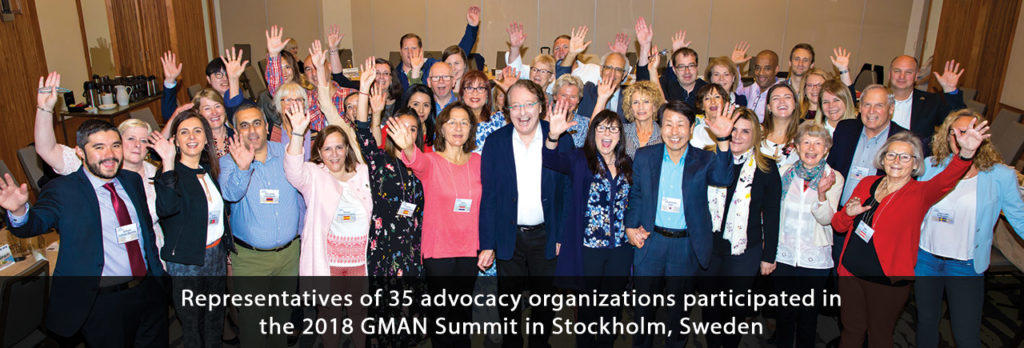
The 2018 Annual Summit of the IMF’s Global Myeloma Action Network (GMAN) convened on June 17–19 in Stockholm, Sweden. The event brought together 35 advocacy organizations representing 25 countries from Asia, Australia, Europe, and Latin and North America. The contributions of Dr. Brian G.M. Durie (IMF Chairman of the Board), Dr. Joseph Mikhael (IMF Chief Medical Officer), Dr. Jean Luc Harousseau (Past President of HAS Institut de Cancérologie de l’Ouest Nantes, France), and industry partners and invited speakers from the US FDA, Stupid Cancer, and Global Alliance for Patient Access (GAfPA) made this meeting one of the most comprehensive ever.
One important conversation at the GMAN’s sixth Summit focused on access disparity faced by patients with myeloma around the globe. Maja Milisavljevi, the representative from Serbia, noted that “novel drugs that are routinely available in the US and some EU countries for over five years are still science fiction for us.” One of the key objectives of GMAN is to reduce these access disparities. GMAN’s other two main objectives are to build the capacity of local myeloma organizations and increase awareness of myeloma worldwide.
At the beginning of the meeting, the recipients of GMAN’s Susie Novis Durie Award were announced. In its third year, this competitive award encourages member organizations to develop an innovative program or product that raises awareness and builds capacity of the patients, primary care providers, and hematologists in their countries. Using this grant, Comunidad Española de Pacientes de Mieloma Múltiple (CEMMP) from Spain will develop a smartphone app for myeloma patients and healthcare professionals educating them on nutrition, health, and lifestyle. The Israeli Association of Myeloma Patients (AMEN) will use the funding to raise awareness about early detection of myeloma among families and physicians via social networks and other public venues. Myeloma Canada will use the grant to develop the Myeloma Advocacy Program (MAP) campaign.
The recipients of last year’s Susie Novis Durie Award showcased their work, which ranged from Argentina’s educational program for 100+ hematologists and 160 myeloma patients in remote parts of the country, to Austria’s mobile-enabled online course for patients with myeloma and their families, to Romania’s general and myeloma-specific training initiative for more than 300 nurses.
Capacity building of the member organization continued with Dr. Durie giving GMAN members an overview of IMF’s Black Swan Research Initiative Global Technology Platform™, an initiative that advances the causes of early detection and full sequencing of myeloma, clinical trials with curative intent for smoldering patients, single cell resistance and DNA mutation analysis, and retrospective and family studies. This worldwide collaborative effort is driven to continue improving patient outcomes in myeloma.
Dr. Mikhael provided a highlight of ASCO, IMWG, and EHA meetings that took place days before. He spoke with excitement about CAR T cell therapy, the use of pomalidomide early in relapse, the convenience and effectiveness of once-a-week carfilzomib, and the combination of daratumumab + carfilzomib. Dr. Mikhael also discussed drugs in the clinical trial pipeline such as selinexor, venetoclax, isatuximab, anti-CD38 antibody MOR202, and others.
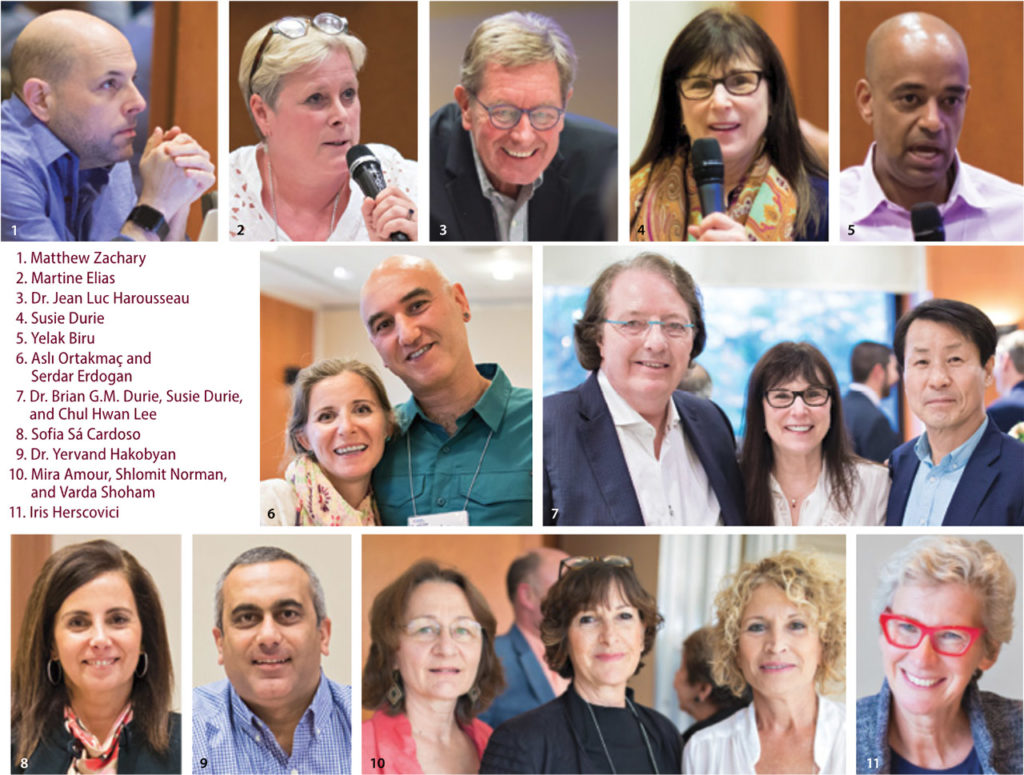
Matthew Zachary, founder and CEO of Stupid Cancer, presented “Patient Advocacy on Your Own Terms” and focused on the unmet needs of adolescents and young adults living with cancer, as well as his personal journey of self-advocacy for choice. Matthew concluded his talk asking “How can we guarantee access and choice?” and affirming that “Patient Experience Matters.”
Dr. Arturo Loaiza-Bonilla gave an overview of Global Alliance for Patient Access (GAfPA), a network of physicians and patient advocates with the shared mission of promoting health policy that ensures patient access to appropriate clinical care and approved therapies. Dr. Loaiza-Bonilla highlighted the importance of working with Contract Research Organizations (CROs) to bring novel therapies through clinical trials to underserved countries.
Dr. Harousseau reminded attendees that although the costs of new therapeutic agents represent only 15% of the total healthcare expenditure, this is a critical concern in myeloma due to longer survival of patients, triple and quadruple combination treatments, and the “treat until progression” concept. With more innovative and expensive treatment options, such as CAR T Cell therapy, checkpoint inhibitors, and bispecific antibodies being just around the corner, drug prices have not yet hit bottom. It was agreed that one entity will not be able to solve this issue; patients, physicians, payers, policy makers, and pharmaceutical companies need to come together to address this concern.
Every year that I attend the GMAN Summit, I am reminded of this quote from Susie Durie, President & CEO of the IMF, “Myeloma doesn’t stop at the border, why should myeloma treatment?”
While the law in Argentina grants equal rights to all, not all myeloma patients have equal access to the same treatment options. FAM seeks to achieve equality of care for all people with myeloma, empowering patients and caregivers to overcome avoidable obstacles on the path to treatment. The 2017 Susie Novis Durie Grant will enable FAM to train an educator who will travel to remote regions of low economic resources and lack of access to means of communication, to deploy this educator to 5 identified regions to visit local patients and medical treatment centers, and to organize regional meetings for patients and caregivers with the participation of local healthcare professionals. FAM staff will continue to offer support and assistance to this newly formed network of myeloma patients and healthcare providers from FAM’s headquarters in Buenos Aires. We are very excited to have the support to fulfill one of our objectives: to reach more myeloma patients throughout Argentina, says Mariana Auad, FAM Coordinator General.
Austria: Myelom- und Lymphomhilfesterreich
Improving and enhancing the comprehension of medical information about myeloma is an important contributing factor to patient outcomes and quality of life, and ensures that patients are better able to take a participatory role in their medical care. In Austria, there is a pressing need to ensure that the education of myeloma patients and their loved ones is made as easily accessible and digestible as possible. This project will create and produce an engaging, user-friendly, web-based lesson plan about the many aspects of myeloma and its treatment, thereby raising awareness and facilitating the integration of myeloma education into the challenging daily lives of patients and caregivers. We are opening a new chapter of informing-tools, says Elfi Jirsa, President of Myelom- und Lymphomhilfe sterreich.
Romania: Myeloma Euronet Romania (MER)
The 2017 Susie Novis Durie Grant will support the implementation of one of MERs most important objectives in the capacity building of Romanias medical nurses. Due to the current struggle with a shortage of medical doctors to provide adequate care to patients with myeloma, the role of medical nurses in Romania is progressively more essential to both the quality of care and the quality of life of patients with myeloma. This project will build the professional capacity of nurses by supporting a formal, expert-driven, two-day training session for nurses, while also addressing improving the relationship between nurses and patients in alignment with EU medical and ethical standards. On behalf on the Romanian patients whom I represent, I would like to express my gratitude for your consideration of our project, says Viorica Cursaru, MER Director General, In as much as I am concerned, I am deeply touched by your understanding of our situation as well as your willingness to assist us in addressing it.
We Thank Our Sponsors: Amgen, Bristol-Myers Squibb, Celgene, Genentech, and Takeda.
GMAN members play a critical role in improving the lives of myeloma
patients in their countries. We are fighting against a global disease,
identifying priorities and supporting innovative solutions. The projects
chosen for Susie Novis Durie Grant 2018 show great promise and were
selected for both their creativity and awareness of the current
landscape in multiple myeloma.
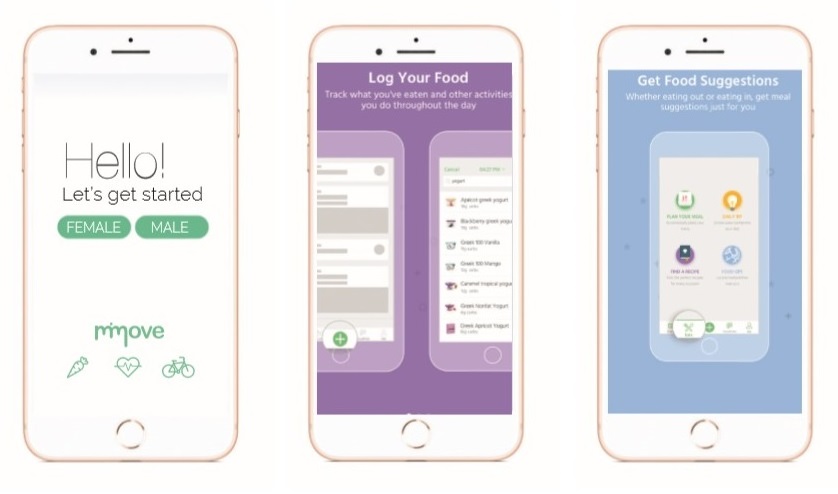
Comunidad Española de Pacientes de Mieloma Múltiple (CEMMP) from Spain has started developing a smartphone application for patients and healthcare professionals, educating them on the role lifestyle and nutrition play in patient health. The Spanish Community of Multiple Myeloma Patients has designed Mimove app to solve a problem that myeloma patients struggle with every day: there is a vast quantity of contradictory information available about nutrition and healthy lifestyle habits, compatible with this disease. Patients are exposed to many confusing tips about nutrition and physical activity. Myeloma patients have questions such as: “What should I eat to feel better?” or “Can I practice any sports?”
Mimove offers “a personalized road map” to learn to eat healthier,
including some advice for physical activity, based in part on the
patient’s mood and strength. The patients will also be able to track
their clinical tests in order to see the evolution of results. There
will be a collaboration by dieticians specialized in myeloma, personal
trainers, and hematologists that will oversee the information provided.
As it is an application for smartphones, the information is readily
available and up-to-date. It will also offer the patient the possibility
of sending statistical data on his physical activity, mood, and
nutrition to the doctor! As this app may be interesting for any myeloma
patient, no matter where they live, after launching the app in Spanish,
we are considering the possibility of launching it in English as well.
The Israeli Association of Myeloma Patients (AMEN) will use social network and publicity to raise awareness about early detection of myeloma among families and physicians. A study among 200 myeloma patients found that the time elapsed from the appearance of symptoms to diagnosis of multiple myeloma was 6 months when using a family doctor and 10 months when seeing an orthopedic doctor on average. Late diagnosis causes unnecessary suffering and complications due to the disease. In order to shorten the time of diagnosis, it was decided to embark on a unique project aimed at advancing the early diagnosis of multiple myeloma by both family and orthopedic doctors. The chairman of the Hematology Association and chairman of the Orthopedic Surgery Association gave their patronage, and the association invited the doctors to receive information that will assist in early diagnosis. AMEN produced short movies that were sent to 5800 doctors by mail and were advertised on relevant web sites and promoted in social networks.
In Israel, there are almost 500 newly diagnosed myeloma patients
every year. This awareness campaign will improve the time period for
early diagnosis and will help patients to suffer less from bone
fractures, anemia, and kidney problems.
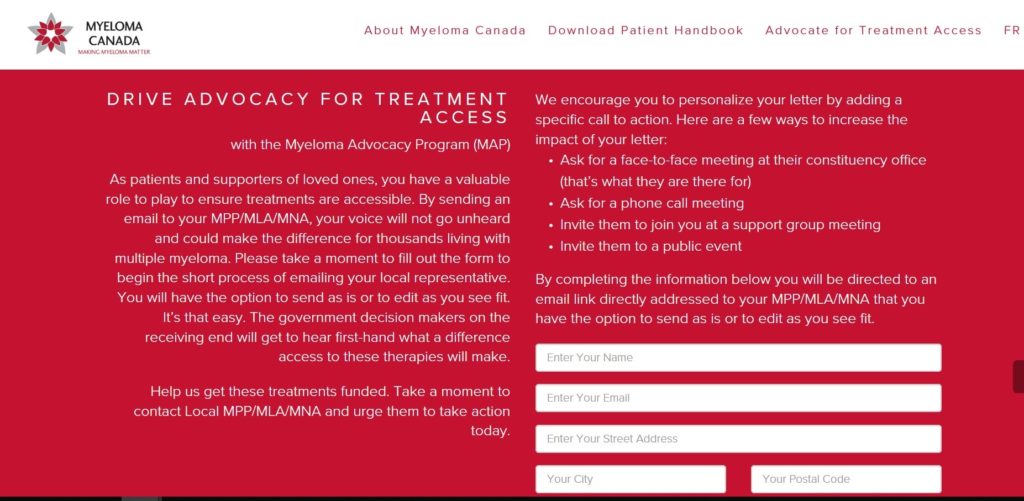
Myeloma Canada is using the grant to develop the Myeloma Advocacy
Program called MAP which raises awareness for patients, caregivers, and
healthcare providers. Access to effective cancer treatments is a right
of every patient. By working together, the stronger, louder, unified
patient voice has clearly demonstrated that it can make a difference in
the Canadian myeloma community.
In recent years, several game-changing therapies have become
available in Canada. Although many patients are living longer and
enjoying productive lives, reimbursement and timely access to new
therapies remain a challenge for many patients in all Canadian
provinces. As such, with the help of the Susie Novis Durie Grant Myeloma
Canada received in June 2018, we have created an advocacy platform
where citizens can take action. This platform, Myeloma Advocacy Program
(MAP), is accessed via the Myeloma Canada website: http://www.myelomacommunity.ca/.
Individuals log onto MAP to create an individualized letter to be sent
to their local member of parliament or candidate running for office.
GMAN and the Susie Durie Novis grants are bringing people together to
effect change in the myeloma community. By connecting those impacted by
myeloma within each country and across the world, communities are
learning from one another and building off one another’s successes.
Ultimately, the lives of myeloma patients are improved and extended
through the body of work supported by the Susie Durie Novis grants.





Recent Comments